
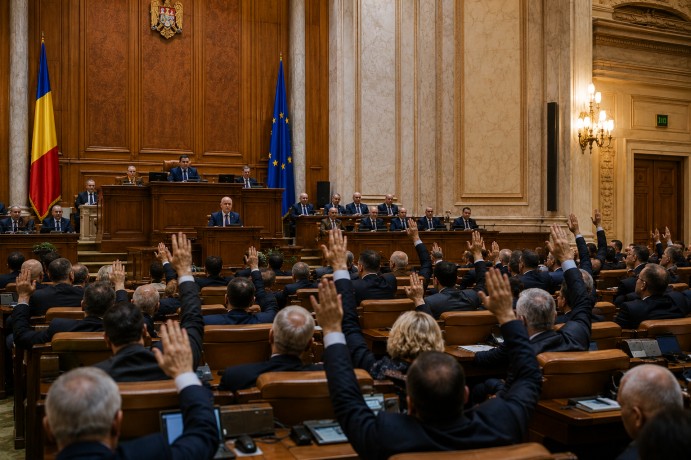
Romania’s political turmoil has intensified as the country’s Parliament failed to approve the cabinet proposed by Prime Minister-designate Adrian Vestea. This marks the sixth straight week without a new government in place. Vestea managed to secure 189 votes, which fell short of the 233 required to gain parliamentary approval. Following the unsuccessful vote, Vestea expressed that he had exerted all possible efforts to establish a government that could bring an end to the ongoing political instability.
With the rejection of Vestea’s proposed administration, President Nicușor Dan is tasked with nominating another prime minister-designate. The new nominee will have a 10-day window to assemble a cabinet and seek the necessary approval from Parliament. According to Romanian law, should two consecutive nominees fail to receive support within a 60-day period, the Parliament may be dissolved, potentially leading to early elections.
The challenge of forming a majority government has been exacerbated by deep-seated political divisions within the country. Analysts now suggest that a minority government may be the most feasible solution to break the deadlock. Meanwhile, Romania grapples with pressing economic issues, such as a significant budget deficit and the imperative need to secure European Union recovery funds.
As the political impasse continues, the urgency for a stable government becomes more pronounced, especially given the economic challenges Romania faces. The current situation leaves the nation in a precarious position, with the unresolved political crisis casting uncertainty over its future economic recovery and stability.