
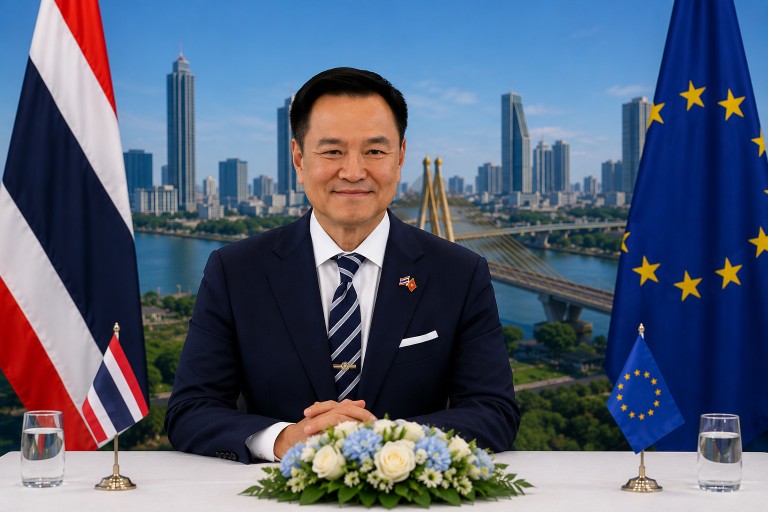
In a bid to enhance economic ties with the European Union, Thai Prime Minister and Interior Minister Anutin Charnvirakul recently engaged with key figures from the EU–ASEAN Business Council and the European Association for Business and Commerce. The dialogue focused on expanding trade, investment, and economic collaboration between Thailand and the EU, underscoring the importance of this partnership for Thailand’s economic growth.
The meeting saw participation from representatives of over 40 prominent European companies, spanning diverse sectors including healthcare, finance, automotive, energy, technology, agriculture, tourism, and consumer goods. This diverse representation underscores the broad interest in strengthening economic ties with Thailand, a nation poised to enhance its role as a significant player in these industries.
Anutin emphasized Europe’s pivotal role as a vital economic partner for Thailand and discussed the government’s strategic plan to bolster the nation’s competitiveness on the global stage. The strategy aims to enhance infrastructure related to digital technology, artificial intelligence, and clean energy. Additionally, there is a focus on upgrading the country’s transport and logistics systems, alongside improving the investment climate through regulatory reforms and pursuing membership in the OECD.
Thailand is positioning itself as a regional hub in several cutting-edge sectors including semiconductor manufacturing, clean energy, AI, digital technology, life sciences, modern agriculture, and food production. This ambition aligns with the country’s broader goal of fostering a robust economic environment that attracts international investment and innovation.
The discussions also reinforced Thailand’s dedication to finalizing the Thailand–EU Free Trade Agreement, a move anticipated to significantly enhance market access for Thai products in Europe. This agreement is expected to unlock new business opportunities and deepen economic connections between Thailand and the European Union, benefiting both regions economically.